Fleet Advantage: 87% of Private Fleets Now Use GenAI
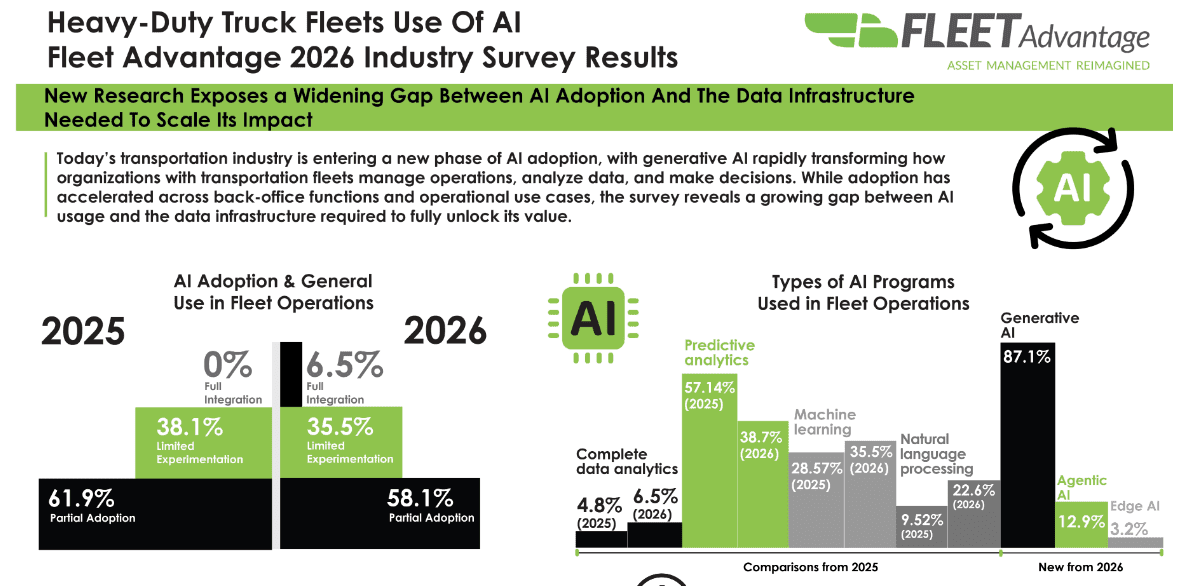
Fleet Advantage surveyed more than 2,500 transportation and private fleet executives and found 87.1% now use generative AI, but data integration, ROI tracking, and TCO modeling remain weak spots.
GenAI Moves From Novelty to Daily Fleet Work
Fleet Advantage says generative AI has moved quickly into private fleet operations, based on an April survey of more than 2,500 transportation and private fleet executives released during the National Private Truck Council's 2026 Annual Conference and Exhibition.
The headline number is blunt: 87.1% of respondents said they now use generative AI large language models. Fleet Advantage said fleets are using the tools for back-office work, driver feedback, and pulling information from documents such as maintenance manuals, compliance guides, and standard operating procedures.
The Operational Use Cases Are Spreading
The survey also showed broader AI use moving deeper into day-to-day operations. Route optimization grew from 42.9% in 2025 to 71% in 2026, maintenance scheduling increased from 33.3% to 64.5%, and fuel-type analysis rose from 0% to 61.3%. Asset lifecycle management climbed from 9.5% to 38.7%.
Safety is part of the shift. Fleet Advantage said 61.3% of fleets now use AI-powered tools for driver monitoring, coaching, and safety management, though 6.5% still reported having no formal driver safety monitoring program.
Data Quality Is Catching Up the Hard Way
The barrier is not interest. It is infrastructure. Respondents citing data integration problems jumped from 38.1% in 2025 to 71% in 2026, while concerns about inaccurate data rose from 23.8% to 64.5%. Lack of AI expertise also increased, from 19% to 45.2%.
The survey suggests fleet leaders are learning that AI tools only work as well as the data underneath them. More than half of respondents said they collect telematics and ELD data but have not integrated it into AI systems, and only 9.7% said they use those streams for real-time AI insights.
ROI Tracking Is Still Thin
Few fleets appear to have a mature way to measure whether the new tools are paying off. Only 9.7% reported having a formal AI ROI tracking framework, while 51.6% track results informally and 19.4% rely on anecdotal assessments.
Total cost of ownership modeling shows the same gap. About 32% of respondents still do TCO work manually, 29% do not perform TCO analysis at all, and AI-driven TCO modeling averaged just 12.1% adoption. For fleets, the practical message is simple: the AI race is no longer just about trying tools. It is about cleaning up the data, workflows, and measurements those tools depend on.